Day 59 Update — DRC Ebola Outbreak (Bundibugyo)
Anchored on the DRC national situation reports N°60 and N°61, covering data through 14 July.

The national cumulative stands at 2,073 confirmed cases and 796 confirmed deaths as of 14 July. The more significant development this week is the rate of change: daily incidence rose to a new high of 62 new confirmed cases in a single reporting period, and test positivity in the epicentre province tripled. The two charts below present the picture at two levels.
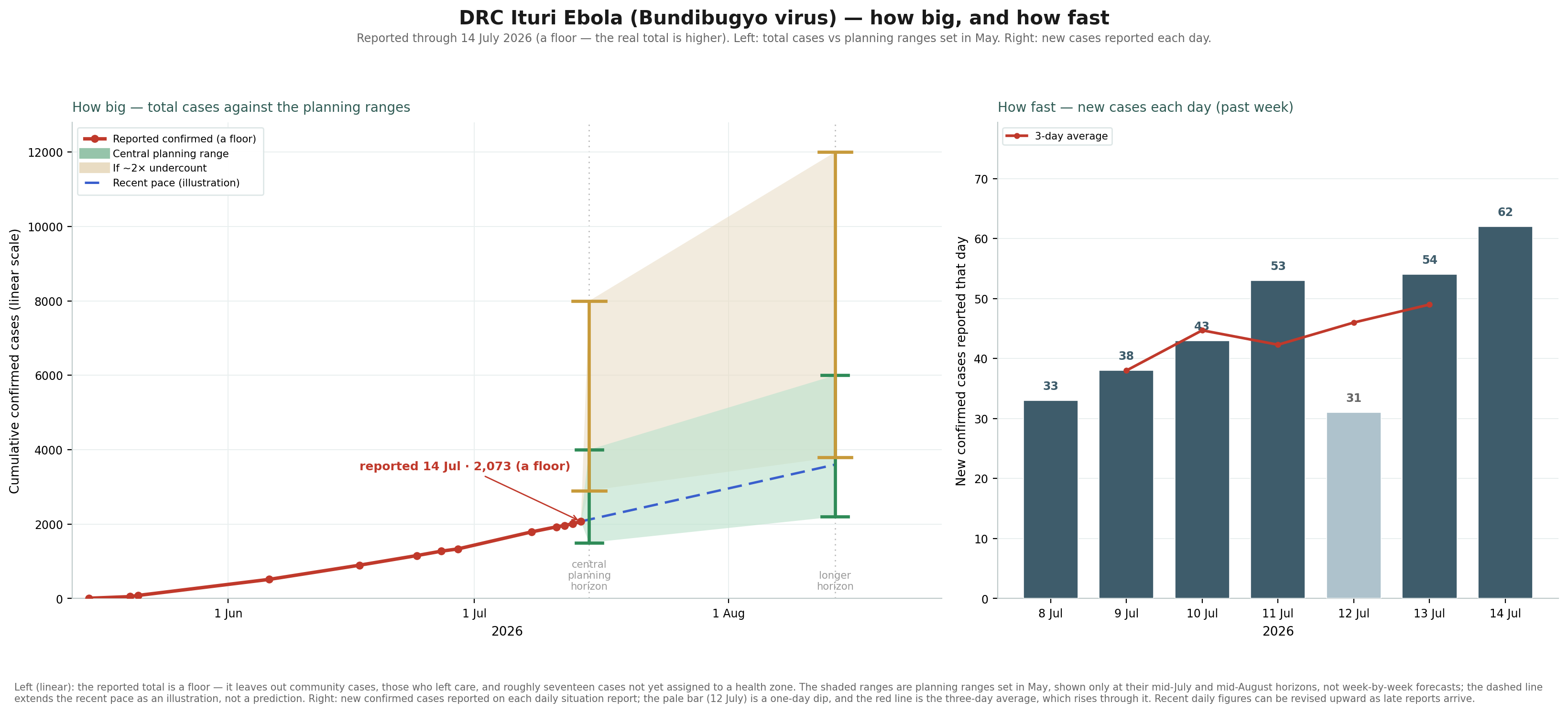
The left panel shows where the cumulative count sits against the planning ranges established in May. The reported total — a floor, as it excludes community cases and those who left care — has reached the near planning horizon and falls in the lower half of the central band. The dashed line extends the recent pace as an illustration only; the last two days landed above it.
The right panel shows daily new confirmed cases over the past week: 33, 38, 43, 53, 31, 54, 62. The single lighter bar on 12 July is a one-day dip; the three-day average (red line) rises through it. The cumulative total rose by 110 across the two reporting periods this week. The most recent daily figures remain subject to upward revision as late reports arrive, which would steepen the picture further.
Test positivity: suggestive of acceleration, but read with caution
A rising case count alone does not resolve whether transmission is genuinely accelerating or whether a recovering surveillance system is finding cases more efficiently. Test positivity can help separate the two, but the laboratory system here carries known deficiencies that limit what the data can support.
In Ituri, positivity ran approximately 13% on 12 July, 18% on 13 July, and 36% on 14 July, while sample throughput over the same three days was 203, 229, and 152. Positivity rose on declining volume, which is consistent with a growing infected pool rather than expanded case-finding. However, several structural problems prevent a confident attribution.
The sample is not a random draw from the infected population. Alert-investigation rates across Ituri zones range from under 30% to nearly 97%, meaning that what reaches the laboratory is heavily shaped by geographic access, team availability, and security conditions — all of which are disrupted in this outbreak. MSF independently reports hundreds of samples currently awaiting analysis; which samples are processed first, when capacity is constrained, is unknown, and a systematic prioritisation toward more severely ill individuals would mechanically inflate positivity regardless of true incidence. The marked difference in positivity between Ituri (36%) and Nord-Kivu (6.4%) — two simultaneously active fronts — is more plausibly a function of who is being tested in each than of a genuine threefold difference in infection rates.
The positivity trend is consistent with real acceleration and is not well explained by a simple “surveillance catching up on a fixed backlog” story. It is not, given these deficiencies, sufficient to rule out remaining ascertainment confounds or to make a confident attribution. The honest read is that the data leans toward genuine transmission growth without confirming it.
Ascertainment and the undercount
The reported total understates the true burden. It excludes individuals with disease in the community who never reach care, those who left care, and approximately seventeen confirmed cases not yet assigned to a health zone. Médecins Sans Frontières, which operates its own treatment centres and tracks its own sample backlog independently of the national surveillance pipeline, reports hundreds of samples currently awaiting analysis. The only published institutional size estimate for this outbreak — an Imperial College / WHO analysis from May — placed the probable true case total at roughly double the then-reported figure. The trebling of positivity this week is consistent with the gap between reported and true burden widening rather than closing.
Geographic extension: Haut-Uélé
In the prior reporting cycle, Haut-Uélé province carried cases that were entirely importation-linked — individuals originating from the Nia-Nia focus in Ituri. That characterisation no longer holds for the full provincial picture. This week, seven additional confirmed cases were recorded across four health zones in Haut-Uélé (Wamba, Pawa, Boma Mangbetu, Isiro), distinct from the earlier imported cluster and presenting predominantly as community deaths. The province now stands at 14 confirmed cases, 13 deaths, and a case-fatality of 93% — consistent with chains being detected at or near the point of death rather than during active illness.
Haut-Uélé is now a secondary focus with confirmed local cases rather than a monitored importation site. Two additional zones in the province (Aba, Doruma) remain in alert status with suspected cases under investigation.
Tshopo province, including Kisangani, has not crossed the same threshold. Its four cases remain traceable to Ituri, and no locally-acquired Kisangani case has been documented. A further confirmed case who absconded from care in Ituri was intercepted and isolated in Kisangani this week, underscoring that the seeding mechanism remains active.
Response conditions
The operational picture deteriorated further this week across several indicators.
A treatment centre in the Nia-Nia (PK51) locality was destroyed by arson. This is the same area from which every confirmed geographic extension in this outbreak — Tshopo, the Haut-Uélé cluster, and the Lubunga detection — has derived. Security incidents at this location have been recorded across multiple prior cycles, but this represents a direct action against treatment infrastructure.
Safe-and-dignified burial operations in Rwampara, one of the two highest-burden health zones, are halted due to non-payment of field teams. Community resistance to burial was additionally recorded in Nizi and Mandima. Burial throughput — a critical variable for limiting community transmission — is therefore compromised in zones carrying a substantial proportion of the national case burden.
Across seven consecutive reporting cycles, patients have absconded from treatment and transit facilities in Ituri on each day, totalling 58 individuals over that period. Over the same interval, Nord-Kivu — operating at or above treatment capacity throughout — recorded zero absconding events. The pattern indicates that patient retention is not a function of facility capacity but of community engagement and trust, the latter of which remains seriously deficient in Ituri.
Frontline-worker infections stand at 119 confirmed cases and 36 deaths.
Forward indicators
Five positions, carried from the last published post. Confidence is expressed in ordinal terms only.
1. The daily case count does not sustain a real decline. — Held; strengthened.
Criterion for revision: confirmed cases per day averaging below approximately 50 across two consecutive weeks. The current pace is 54 and 62 on the last two reporting days, and positivity data supports these as genuine rather than surveillance-driven figures. Most likely.
2. The cumulative count remains within the May planning range at the mid-August horizon. — Held; margin reduced.
Criterion for revision: cumulative confirmed above 6,000 by mid-August. At 2,073 today the position holds, though the current daily pace narrows the buffer more quickly than in prior cycles. Most likely, with less margin than a week ago.
3. The case-fatality rate reflects provincial and detection mix, not pathogen change. — Held; under most pressure of the five.
Criterion for revision: national case-fatality reaching 45% on a stable, non-right-censored base. The current rate is 38.4%, up from 36.4% at the prior post. The national figure averages a 36% Ituri core, a 59% Nord-Kivu front, and a 93% Haut-Uélé focus. The current reading is consistent with late detection and community-death predominance rather than a change in pathogen severity. More likely than not. This is the position we are monitoring most closely; if the 45% threshold is crossed on a stable base, we will report it as a loss.
4. Uganda’s cross-border component remains contained. — Held; firmer.
Criterion for revision: documented community transmission outside Kampala and Wakiso, or a new confirmed Ugandan case. Uganda’s last confirmed case was 21 June — now approximately three and a half weeks quiet — against a source-country epidemic that is accelerating. The Ugandan figures originate with a single national ministry and are relayed rather than independently enumerated, which remains a caveat. More likely than not.
5. Kisangani does not generate a locally-acquired transmission chain in the near term. — Held.
Criterion for revision: a confirmed locally-acquired Kisangani case with documented onward spread. All Tshopo cases remain importation-linked at this cutoff. More likely than not.
Hanging position — unresolved. We carry a longer-horizon position that the first third-country export, if it comes, will arrive via the East African corridor. The medical evacuation of a US national from the DRC to Germany this week does not resolve this: evacuations through a structured medical pathway are a distinct mechanism from the unplanned cross-border movement the position addresses. South Sudan carries no confirmed cases. Unresolved.
Marburg (Uganda) — carried, unrefreshed. The isolated fatal case in Kyegegwa District, notified to WHO on 30 June, remains unchanged. No new institutional reporting has been located. It is carried, not restated as current, and is tracked separately for its implications for laboratory differential-identification reliability.
Assessment
Transmission accelerated over the two reporting cycles covered by this update. The positivity data attributes that acceleration to incident spread rather than surveillance recovery. A secondary focus has become established in Haut-Uélé. Trust and community engagement deficits in Ituri are driving patient absconding at a rate that now rivals recoveries, and those same deficits are the proximate cause of the geographic extensions that have occurred throughout this outbreak. Response security and responder payment continuity are both materially impaired in high-burden zones.
Sud-Kivu has reached 49 consecutive days without a confirmed case and is proceeding toward a formal end-of-epidemic declaration. It is the first provincial focus to be extinguished in this outbreak, and it establishes that containment is achievable where a cluster is detected early and does not extend.
The indicator to prioritise over the next reporting cycle is test positivity. Sustained positivity at or near 36% would confirm that incidence is outrunning diagnostic capacity and that the acceleration is not a transient signal. A return to the low teens, with testing volume stable, would be the first data-supported evidence of slowing.